
📋About Recursion Pharmaceuticals
Updated October 22, 2026Recursion Pharmaceuticals (NASDAQ: RXRX), founded in Salt Lake City, Utah in November 2013, is a clinical-stage drug developer built around machine learning and automated biology. It appears here as an AI-native drug developer: it does not sell an AI product, but uses its own models and data to find and design medicines, which it develops itself or with pharmaceutical partners. Najat Khan, previously Chief Data Science Officer at Johnson & Johnson's pharmaceutical arm, succeeded co-founder Chris Gibson as chief executive in January 2026.
Its defining pattern is industrialized biology. Rather than start from a single hypothesis, Recursion runs automated experiments at very large scale, photographing human cells after thousands of genetic and chemical changes and training models on the results to build what it calls maps of biology. The work runs on BioHive-2, a supercomputer built with NVIDIA, which also invested in the company in July 2023. In June 2025 Recursion and MIT released Boltz-2, a model that predicts both the shape of a protein bound to a drug molecule and how tightly the two bind, under the permissive MIT license for academic and commercial use. The MIT researchers behind it went on to found Boltz. In 2026 the company added AI agents for target discovery, drug design and clinical-trial enrollment, and says the enrollment agent helped raise enrollment rates by 1.3 to 1.6 times against historical benchmarks.
In November 2024 Recursion completed an all-stock combination with Exscientia, the British AI drug-design company, which became a wholly owned subsidiary. The deal added automated precision chemistry to Recursion's biology and brought Exscientia's partnerships with Sanofi and Merck KGaA. In May 2025 Recursion narrowed its pipeline, discontinuing programs in neurofibromatosis type 2, cerebral cavernous malformation and C. difficile infection. As of August 2026 its most advanced program is REC-4881 for familial adenomatous polyposis, a rare inherited condition that causes colon polyps, in a mid-stage trial called TUPELO, where the company has begun talks with the FDA about a registrational study. Behind it sit several early-stage cancer trials, including an LSD1 inhibitor the company describes as AI-designed, plus REC-7735, a PI3K-alpha inhibitor it says took 10 months and 242 synthesized compounds to design.
Partnerships supply much of the funding. Roche and Genentech work with Recursion on neuroscience, and in August 2026 Genentech exercised its first option on a validated target; Recursion reports 216 million dollars in upfront and milestone payments from that collaboration. Sanofi, in immunology and oncology, has paid 134 million dollars to date. Bayer works with it on precision oncology, and Merck KGaA on finding new targets in oncology and immunology. Recursion also licenses patient oncology data from Tempus AI.
The honest framing: Recursion has a very large in-house biology dataset, years of partnered milestones, and a credible open-model contribution in Boltz-2, but no approved drug, and its most advanced program is still in a mid-stage trial. The programs it cut in 2025 are a reminder that better target-finding does not remove clinical risk. Its value rests on trial results, with AI as the lever on how quickly and cheaply candidates reach the clinic. It contrasts with Insilico Medicine, whose lead drug rentosertib has reached Phase III, and with Isomorphic Labs, which licenses its models to large drugmakers while building its own pipeline.
🛠️Products & Tools (1)
AI-native drug developer that builds maps of biology from automated cell experiments; combined with Exscientia, co-developed the open Boltz-2 model with MIT, and partners with Roche, Sanofi, Bayer and Merck KGaA.
Keep track of the companies you’re watching
- Save the companies you want to follow
- Get ⚡ alerts when your saved companies change
- Every product they ship, cross-linked to 1,000+ AI tool profiles
- Today’s top AI Stories — the day’s most important AI news, free
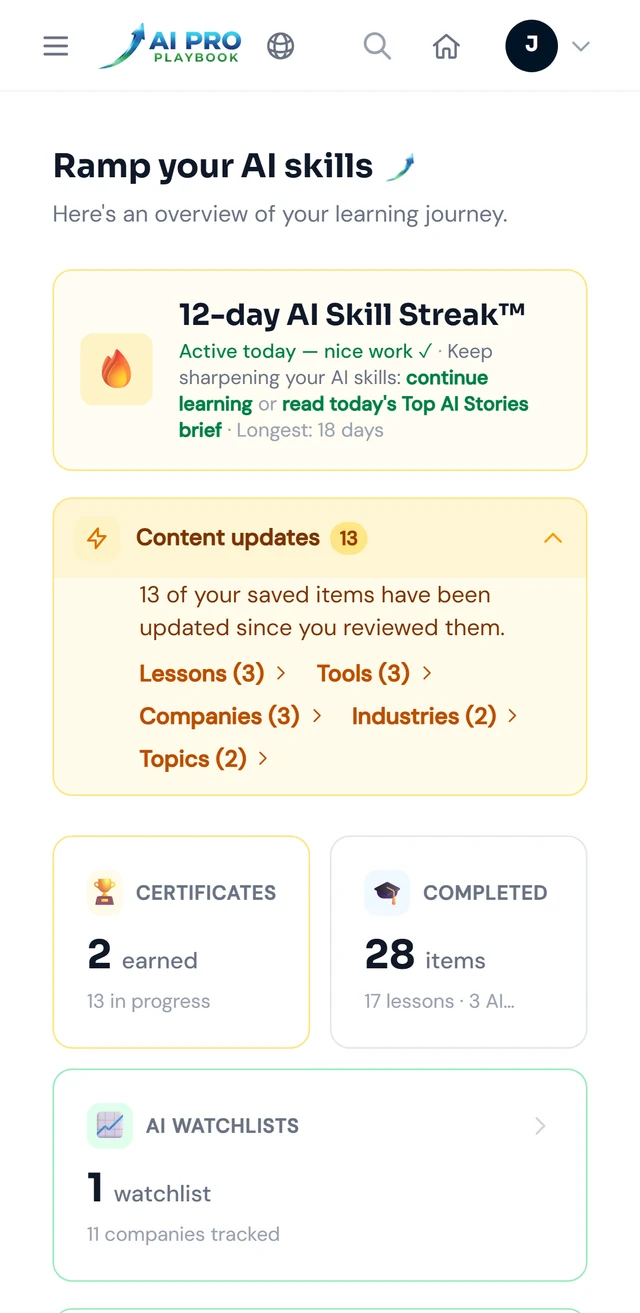
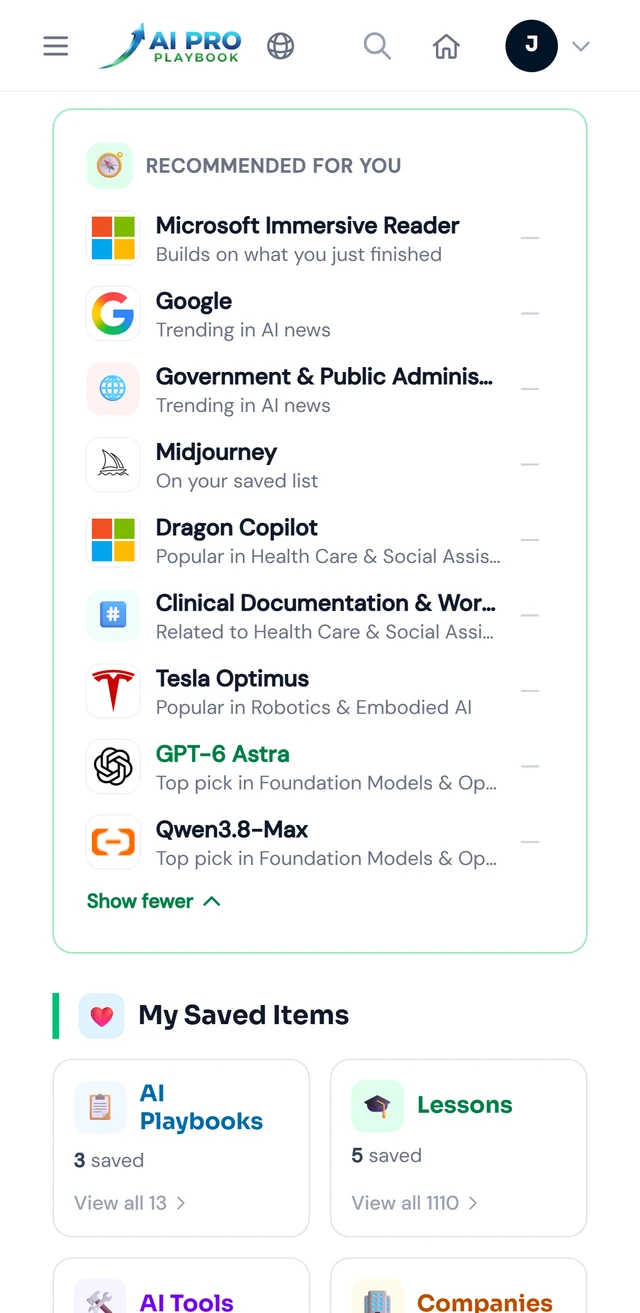
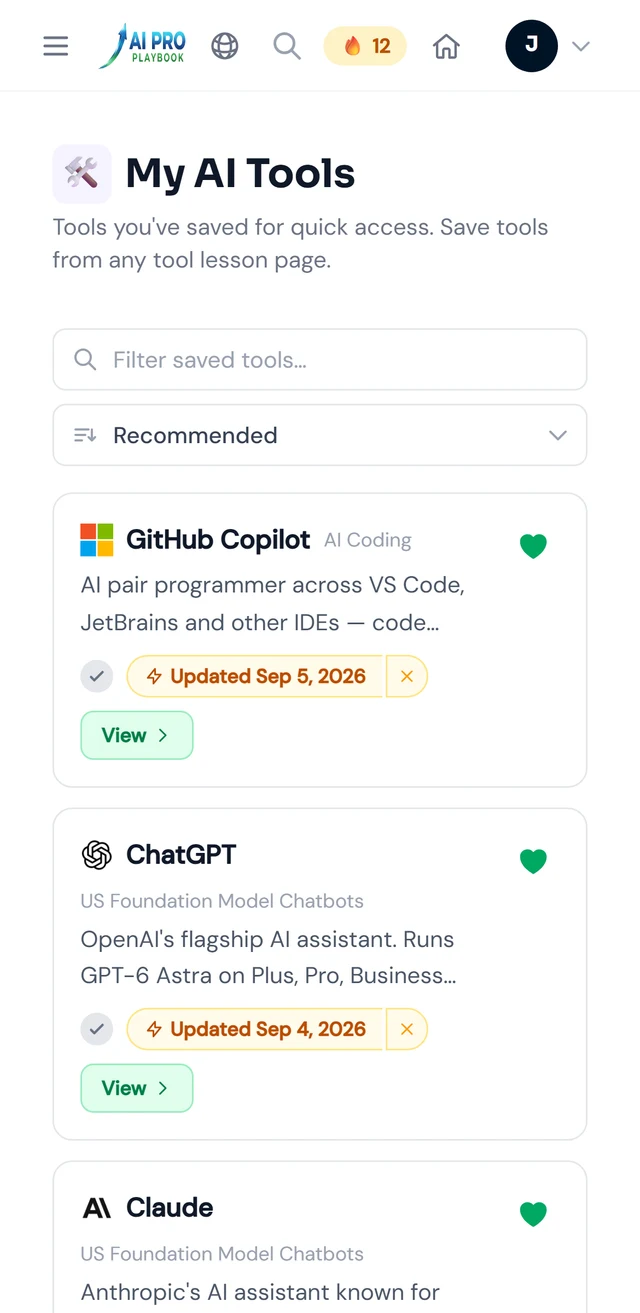
Swipe for Recommended for you and My AI Tools
Your AI Hub — sample data. See desktop view example