
📋About Reflection AI
Updated October 6, 2026Reflection AI is an open-source frontier AI lab building large-scale Mixture-of-Experts (MoE) models with reinforcement learning. Co-founded by Ioannis Antonoglou (founding engineer at DeepMind, contributor to AlphaGo and AlphaZero) and an executive team that pioneered breakthroughs including PaLM, Gemini, AlphaCode, and AlphaProof, the company is headquartered in New York. Reflection AI raised $2 billion in October 2025 with backing from NVIDIA, Sequoia, Lightspeed, B Capital, Citi, CRV, Disruptive, DST, Zoom Ventures, Eric Schmidt, and 1789, valuing the company at $8 billion, and in April 2026 chief executive Misha Laskin confirmed that a new round had closed at a valuation of $25 billion before the new money. Reflection secures the compute to train these models through multi-year deals — including access to Nvidia GB300 systems via European infrastructure provider Nebius running through 2029, alongside an earlier SpaceX lease at its Colossus 2 site worth up to $6.3 billion.
The company's thesis: solving autonomous coding is the most direct path to broader superintelligence, because coding agents must reason, plan, debug, and iterate against real-world feedback signals. Reflection AI's R&D platform combines pre-training and post-training at frontier scale (large MoE architectures) with reinforcement learning loops calibrated against autonomous-coding evaluations. The company commits to releasing models open-source — positioning it alongside DeepSeek and Mistral as a counterweight to closed proprietary frontier model providers.
In May 2026, Reflection AI was named alongside NVIDIA, Microsoft, and AWS as one of four vendors awarded contracts to deploy AI on the U.S. Department of Defense's Impact Level 6 and Impact Level 7 classified networks — the most sensitive systems short of compartmented intelligence. The deals follow earlier agreements with Google, SpaceX, and OpenAI, marking Reflection AI's emergence from pure research into operational defense AI deployment.
Three weeks later, the U.S. Department of Energy selected Reflection AI as primary model provider for the Genesis Mission — a federal scientific-research push launched in late 2025 to fuse quantum computing with AI — across all 17 of the DOE's national laboratories. CEO Misha Laskin framed the choice as a deliberate policy bet, noting that researchers cannot do scientific discovery on a closed model because they need to inspect, fine-tune, and reproduce model behavior in ways closed APIs do not allow. Read together with the Pentagon IL6/IL7 selection, the two federal deployments draw an unusually clean contrast in US AI procurement — closed-source frontier models for defense and intelligence workflows, open-source frontier models for scientific research and shared infrastructure — and position Reflection AI as the default US federal open-source frontier-model vendor.
On October 5, 2026, a day after Axios reported that a release was close, Reflection announced Beam, its first open-weight model: a text-only mixture-of-experts model with 501 billion total parameters, 23 billion active at a time, and a one-million-token context window. Reflection says it matches Z.ai's GLM-5.2 on reasoning tests at three to four times less inference compute, while its own tables show it trailing Kimi K3, GLM-5.3 and Qwen3.8-Max on most coding and agentic tests; none of these results had been independently checked. The weights, a technical report and a model card were promised for later in October, with an early-access waitlist in the meantime. Its longer-term product is an "AI factory," in which an organization combines its own private data, Reflection's models and computing power it controls to build a cheaper customized system, an idea it is testing with South Korea's Shinsegae Group. Until Beam's weights and a license are public, its open-source commitment is a stated intent rather than something buyers can check.
🛠️Products & Tools (1)
Open-source frontier AI lab founded by ex-DeepMind researchers, building large Mixture-of-Experts models with reinforcement learning. Valued at $25 billion in a 2026 round and selected for Pentagon classified networks and the DOE Genesis Mission, it announced Beam, its first open-weight model, on October 5, 2026, with the weights promised later that month.
Keep track of the companies you’re watching
- Save the companies you want to follow
- Get ⚡ alerts when your saved companies change
- Every product they ship, cross-linked to 1,000+ AI tool profiles
- Today’s top AI Stories — the day’s most important AI news, free
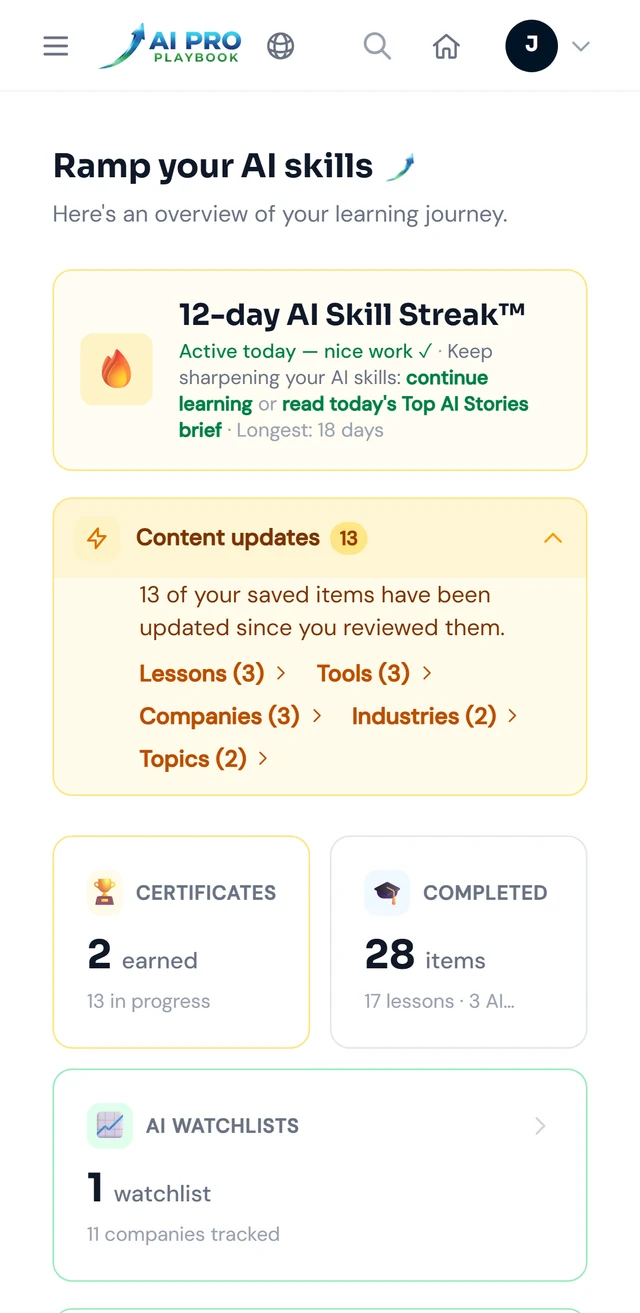

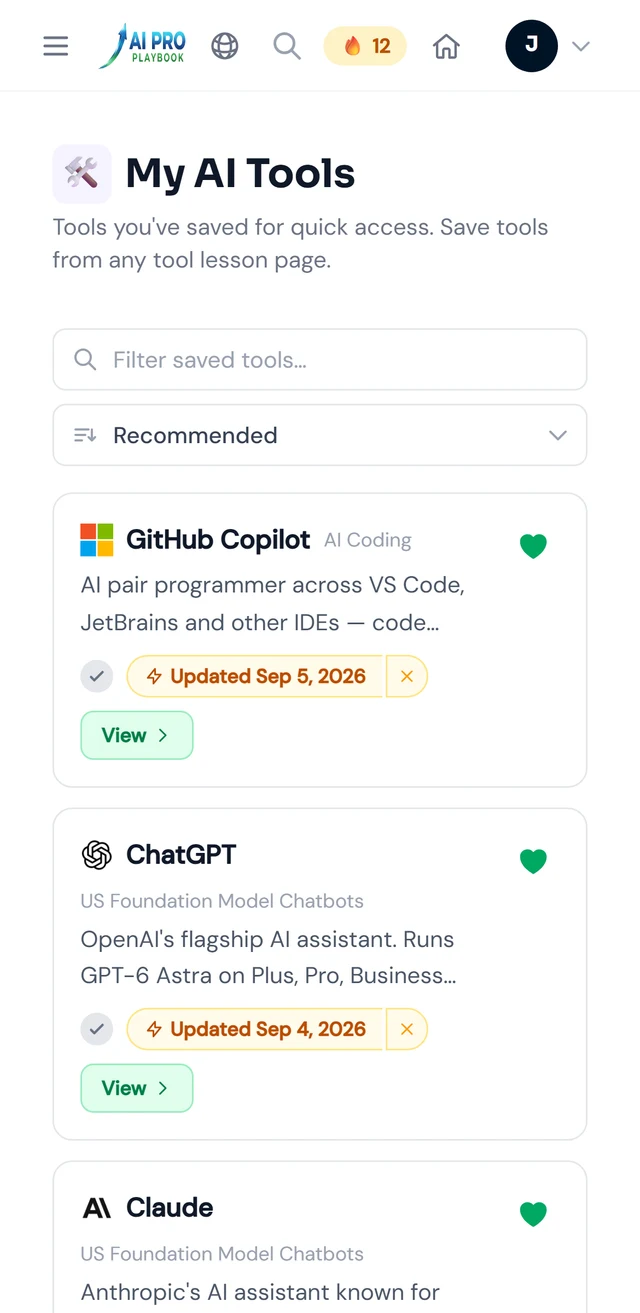
Swipe for Recommended for you and My AI Tools
Your AI Hub — sample data. See desktop view example