
📋About SpaceX
Updated September 16, 2026SpaceX is an aerospace company founded in 2002 by Elon Musk, now one of the most consequential players in AI infrastructure after a February 2026 all-stock acquisition of xAI. In June 2026 the combined company completed the largest initial public offering in history — raising about $75 billion and listing on the Nasdaq under the ticker SPCX, worth more than Tesla on its first day of trading. In the days after listing the stock climbed well above its offer price, briefly making the combined company one of the most valuable in the world — momentarily ahead of Amazon. Days later the company agreed to acquire the AI coding startup Cursor (Anysphere) in an all-stock deal worth roughly $60 billion — its largest acquisition ever — and that purchase closed on August 14, 2026, folding the leading AI code editor and its developer base into the SpaceXAI division. It is the largest price ever paid for a startup, and it means one company now owns a frontier lab, the compute that trains it, and the editor a large share of professional developers work in. The offering was positioned explicitly around orbital AI data centers, reframing what was historically a launch-and-broadband company as an AI compute provider, and it took Musk's AI arm public alongside the rockets: xAI, the Grok model family, and Starlink now sit inside one publicly traded company.
SpaceX's AI infrastructure strategy has three layers. First, Starlink V3 satellites — launching 60 per Starship starting 2026, each with 1 Tbps download capacity and terabit-class laser mesh networking — are designed to serve as distributed orbital compute nodes, with a long-term FCC filing authorizing up to one million satellites functioning as orbital AI data centers. In July 2026 it filed a fresh FCC application for up to 100,000 third-generation Gen3 Starlink satellites — larger, multi-gigabit spacecraft pitched explicitly as AI-connectivity infrastructure for the compute buildout. In June 2026 SpaceX gave that ambition a concrete first product: AI1, a dedicated orbital data center satellite carrying a roughly 150 kilowatt compute payload (about one Nvidia GB300 rack) cooled by a deployable liquid radiator, with prototype launches targeted for early 2027. AI1 will be mass-produced at the new Gigasat factory — an 11 million square foot, vertically integrated campus in Bastrop, Texas that spans the full satellite supply chain from solar cells to finished spacecraft. Second, SpaceX is a founding partner in Terafab, the chip foundry joint venture with Tesla, xAI, and Intel that will produce radiation-tolerant silicon for SpaceX's orbital inference workloads — confirmed in August 2026 for a Grimes County, Texas site with a $16.8 billion first phase, and weighted heavily toward SpaceX, which Musk has said accounts for roughly 75 percent of planned output. SpaceX's own S-1 describes the arrangement as a general framework carrying no binding commitment. Third, SpaceX co-owns xAI's Colossus training cluster (555,000 GPUs in Memphis, expanding to 1 million by late 2026) and the Grok model family.
The Musk-ecosystem integration — Tesla (vehicles, Optimus, Dojo), xAI (models, Colossus), SpaceX (launch, Starlink, Terafab) — represents one of the most ambitious vertical-integration bets in the AI industry, spanning chip design, fabrication, data center infrastructure, ground deployment, and orbital compute. A successful execution would create the first credible non-NVIDIA frontier AI platform at scale; skeptics note that Tesla's lack of foundry experience and the AI5 chip's roughly two-year slippage signal serious execution risk.
Through its xAI subsidiary, SpaceX has commercialized its compute to outside customers: it leased the Colossus 1 cluster to Anthropic in the largest disclosed AI cloud contract to date, and separately agreed to supply roughly 110,000 NVIDIA chips to Google — a deal worth close to $30 billion over three years — as bridge capacity for Google's Gemini platform. In June 2026 it added a third tenant — the open-source lab Reflection AI, which agreed to lease Colossus 2 capacity near Memphis for about $150 million a month through 2029, up to $6.3 billion in total, on NVIDIA GB300 chips. These multi-customer contracts reposition the combined SpaceX/xAI entity as both a frontier model developer (via Grok) and a neocloud operator selling capacity to external labs — with even the newer Colossus 2 buildout now partly leased to outside demand rather than reserved solely for xAI's own training. The IPO prospectus also exposed the strain inside that bet: xAI lost $2.4 billion in the first quarter of 2026 — up sharply from a year earlier — even as consumer usage of its Grok assistant slipped, the very softening that freed the Colossus 1 capacity now rented to Anthropic.
In April 2026, SpaceX was among twelve companies selected for space-based-interceptor prototype work under the US “Golden Dome” homeland missile-defense program, alongside its Starshield and tracking-layer launch role.
SpaceX reported its first quarterly results as a public company on August 4, 2026, giving the first clean public read on how large the AI business had become. The AI segment, which has housed xAI and X since the February merger, contributed $2.6 billion for the quarter; Connectivity added $4.3 billion as Starlink subscribers doubled to 12 million, and Starship $962 million. The loss narrowed year over year. The spending line moved the other way: the AI infrastructure budget is now approaching $16 billion, up from the roughly $12.7 billion the company projected at its IPO roadshow two months earlier. Investors read the report as a spending story rather than a revenue beat, and the shares closed below their offer price.
Two external facts round out the picture. Nvidia is now among SpaceX's largest disclosed shareholders: a 13F filing on August 14, 2026 showed roughly 122.8 million Class A shares, worth about $21 billion at the June 30 close and marked nearer $17 billion by mid-August. The position is not a new investment — it came from Nvidia's $10 billion stake in xAI, which converted when SpaceX acquired xAI in February 2026, and it makes SpaceX Nvidia's second-largest disclosed holding. The orbital-compute plan also faces an unresolved environmental question. On July 8, 2026 Earthjustice petitioned the Federal Communications Commission on behalf of DarkSky International, Public Employees for Environmental Responsibility and Environment America, asking it to pause licensing of space-based data centers until it prepares a programmatic environmental review. The petition points at satellite burn-up on re-entry and at the replacement cycle implied by putting compute in orbit, since semiconductors age out in roughly three to five years against five to fifteen for telecommunications satellites. The FCC has not ruled, and it is separately weighing a rule that would exclude satellite operations from environmental review altogether — so the outcome could be either a first-of-its-kind review of an AI compute constellation or a categorical exemption for it.
Powering the compute has become its own manufacturing problem. In August 2026 Elon Musk confirmed that SpaceX is adding a blades-and-vanes foundry at Bastrop, Texas, where the company acquired roughly 830 acres near its existing Starlink factory between March and June. Musk's argument is that casting turbine blades and vanes — rather than assembling the turbines themselves — is the limiting factor in bringing new gas generation online, and that casting them in-house could cut as much as 18 months from that wait. The backdrop is a target of roughly 10 gigawatts of AI computing capacity by the end of 2027. The move says something about where the constraint on frontier AI now sits: SpaceX is vertically integrating into metal casting because the alternative is queueing behind every other buyer for the same parts. It carries a cost the company does not bear alone, though — gas turbines emit smog-forming compounds and hazardous air pollutants, and the National Association for the Advancement of Colored People has repeatedly accused xAI of running its Memphis turbines without the permits and pollution controls federal law requires.
🛠️Products & Tools (2)
SpaceX's third-generation satellite platform — 1 Tbps per satellite, terabit-class laser mesh, 60 per Starship launch — designed to double as distributed orbital AI compute nodes. January 2026 FCC filing requests up to 1 million satellites functioning as orbital AI data centers.
SpaceX's government and national-security space stack — a militarized variant of Starlink for secure communications, hosted payloads, and Earth observation. Its proliferated low Earth orbit constellation exceeds 200 satellites, with AI essential to manage the network and process sensor data on orbit. Won a $2.29 billion US Space Force SDN Backbone contract in May 2026.
Keep track of the companies you’re watching
- Save the companies you want to follow
- Get ⚡ alerts when your saved companies change
- Every product they ship, cross-linked to 900+ AI tool profiles
- Today’s top AI Stories — the day’s most important AI news, free
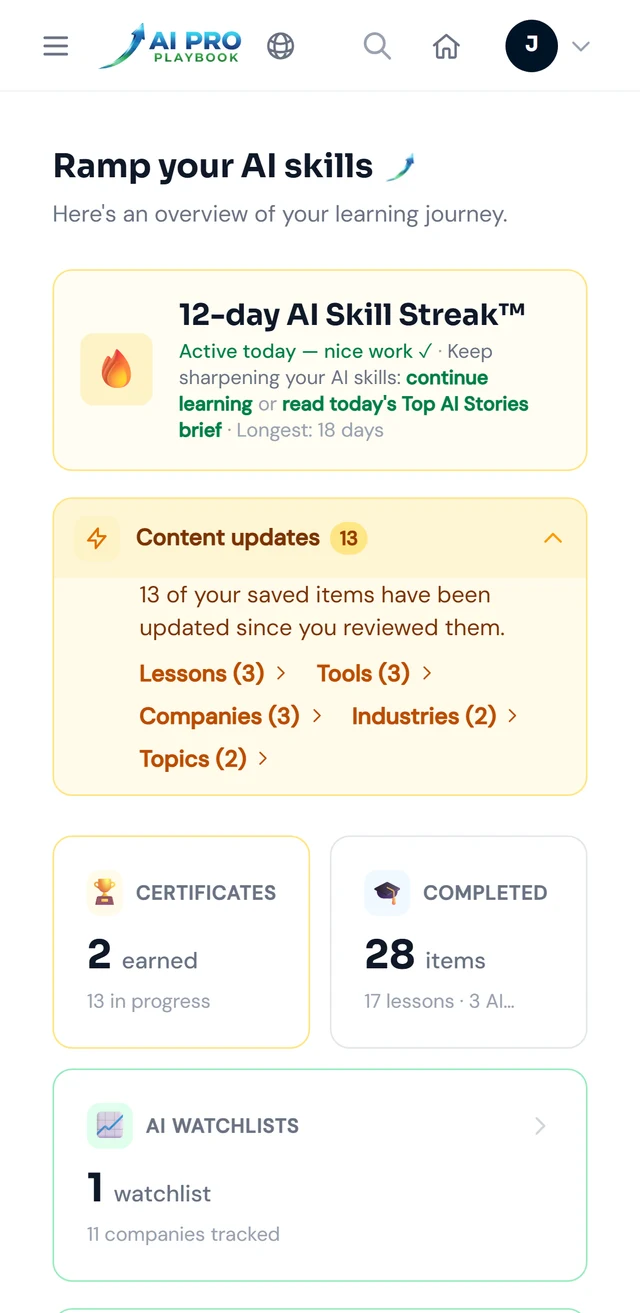
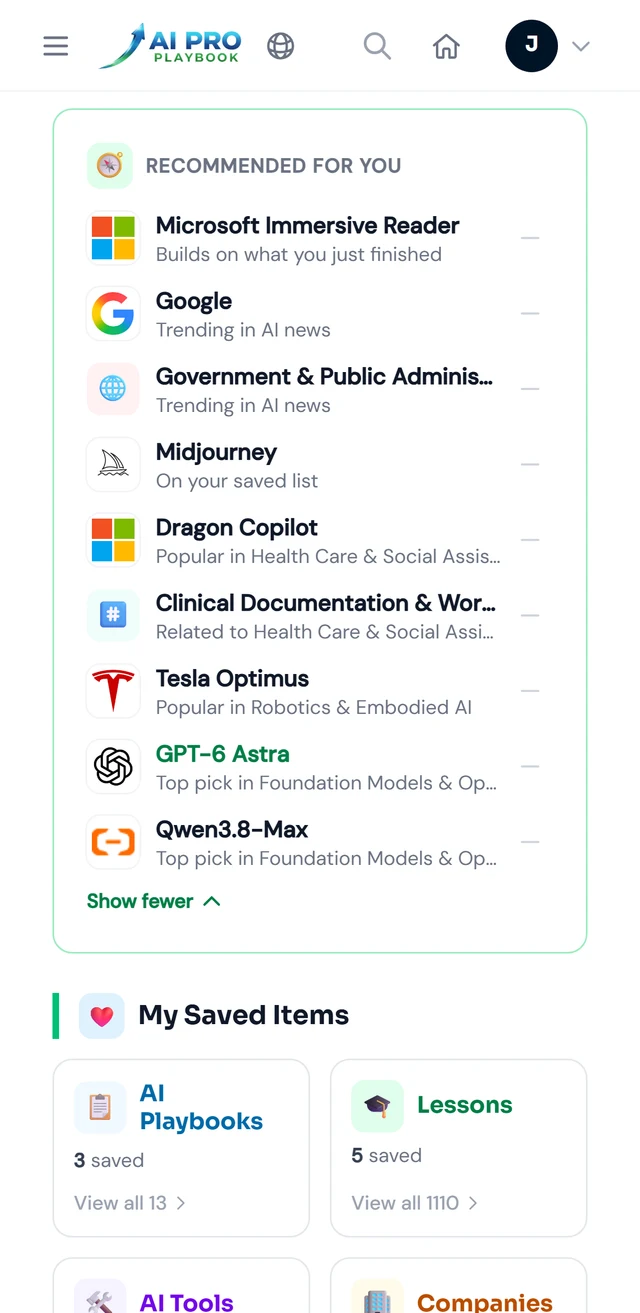
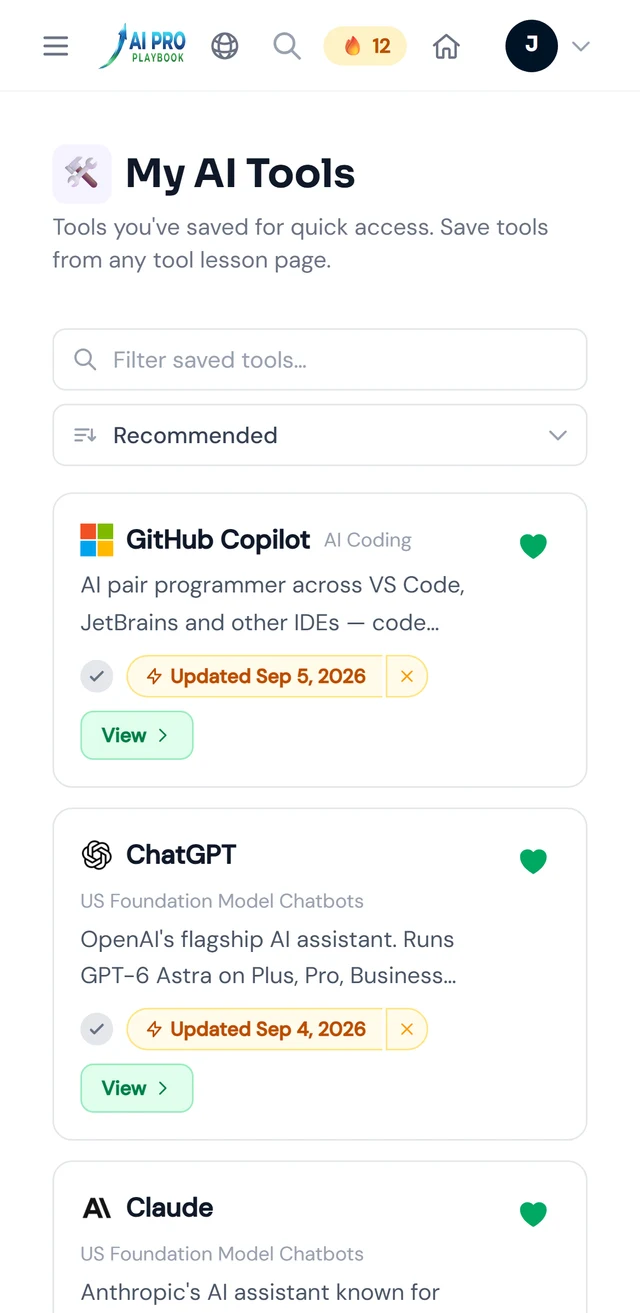
Swipe for Recommended for you and My AI Tools
Your AI Hub — sample data. See desktop view example