
📋About Anthropic
Updated November 20, 2026Anthropic is an AI safety company founded in 2021 by Dario Amodei, Daniela Amodei, and several former OpenAI researchers, and is headquartered in San Francisco. Its founding thesis — that capability and safety have to advance together — shapes its research agenda and is the clearest line of difference from the other frontier US labs. The company is backed by a mix of financial and strategic investors, the largest being Amazon, which has committed over 13 billion dollars across rounds, and Google; semiconductor partners Samsung, SK Hynix and Micron joined the most recent round. Anthropic reached its first profitable quarter in June 2026, before rushed short-term compute pushed the September quarter back to a loss, and in October 2026 it made its IPO filing public. It began trading on the Nasdaq under the ticker ANT on November 19, 2026, after pricing its shares at $83, and the offering raised $81.3 billion, the largest initial public offering on record.
Anthropic is controlled by its Long-Term Benefit Trust, a small body of external trustees who hold no equity in the company yet elect a majority of its board through their own class of shares. The public filing keeps that structure and adds a single founder share that gives the seven co-founders 50.1 percent of shareholder votes with no economic rights, plus a separate share class for employees. Corporate-governance scholars argue the design hard-wires a conflict between profit-seeking investors and self-appointed trustees, and because the trust has so far acted in an advisory capacity, how much constraint it can actually apply remains untested. Anthropic has added outside checks too: independent evaluators embedded inside the company since September 2026, and since October six researchers from the nonprofit METR with the right to publish findings Anthropic cannot veto; METR's first assessment, in November, concluded that AI use had roughly doubled the pace at which Anthropic's models improve, though Anthropic redacted most of the supporting evidence. Also in October, it announced a Public Benefit Fund to hold 5 percent of its shares, subject to stockholder approval. Its amended IPO filing in November 2026 went further, warning that its internal estimates for future models indicate it may soon meet its own policy's threshold for "dramatically accelerated progress attributable to AI," and that it is considering policy changes to keep humans in control of building future frontier models. With Claude Fable 5.2 that month, it said it had deliberately limited, during training, the model's skill at the research that most directly speeds up AI development.
The company develops the Claude family of large language models, which runs from a public flagship through an economical near-frontier tier to a balanced workhorse and a fast, inexpensive tier — alongside Claude Mythos, an unrestricted frontier-cybersecurity line held back from general release and deployed instead through a defensive-security partnership with roughly 50 organizations. Beyond the models, Anthropic ships agentic products including Claude Code, Claude Cowork and managed agents, plus vertical lines for legal and small-business customers. It also runs its own wet biology lab in the Bay Area, focused on fundamental biology rather than drug discovery. It originated constitutional AI, the Model Context Protocol now adopted across the industry, and the Claude Agent SDK. Claude is distributed through a direct API and through Amazon Bedrock, Google Cloud Vertex AI and Microsoft Foundry.
Anthropic runs on leased capacity rather than data centers it owns, and the financing is as distinctive as the scale. It has committed to a multi-year purchase of Google Cloud capacity worth roughly 200 billion dollars, most of it Google's own tensor processing units, and has signed a run of multi-billion-dollar leases with specialist AI cloud providers on top of that, including its first site in Canada, a Nova Scotia campus due to come online in 2027. The chips are largely leased rather than bought: a private-credit vehicle buys the hardware and leases it back, so a very large book of chip contracts depends on Anthropic meeting its lease payments. The company has also begun recruiting a custom silicon team to co-design hardware and models, though nothing has been taped out.
Two disputes sit on the company permanently enough to belong in its profile. Anthropic chose contract terms covering autonomous weapons and mass surveillance over US defense access — the first frontier lab to make that trade — and litigated the resulting procurement standoff, winning at the district level while an appeal continues; adoption has meanwhile kept deepening at the intelligence-agency level. Separately, it carries the industry's heaviest copyright-litigation load, having settled Bartz v. Anthropic for 1.5 billion dollars, the largest copyright settlement in US history, on a holding that training on lawfully acquired books is fair use while storing pirated copies is not. Because Anthropic settled rather than appealing, that split never became binding precedent and the settlement granted no forward license, so training-data provenance remains a standing financial risk rather than a settled question.
🛠️Products & Tools (15)
Composable APIs for building and deploying cloud-hosted AI agents at scale — Anthropic handles orchestration, scaling, and monitoring (public beta)
Anthropic's official SDK for building custom AI agents with Python and TypeScript. Built-in file operations, shell commands, web search, and MCP integration. Sub-agents, background tasks, and Xcode integration.
Anthropic's autonomous coding agent — multi-step coding, debugging, git and MCP tool use in the terminal or in cloud sessions, where redesigned projects split one goal into parallel threads. Runs on Anthropic's Claude Fable, Opus and Sonnet models.
Anthropic's Chrome extension that lets Claude read and interact with web pages. Ask questions about any page or have Claude help complete browser-based tasks.
Anthropic's API capability for controlling desktop computers. Claude can view screenshots, move the mouse, click, and type to complete complex workflows.
Anthropic's public flagship (November 9, 2026) — a safeguarded Mythos-class model that leads most of Anthropic's own benchmarks, at $8 input and $40 output per million tokens, down from Fable 5.1. Anthropic deliberately limited its skill at speeding up AI research, and sensitive cyber and bio requests fall back to older Opus models.
Anthropic's recommended everyday model (September 22, 2026) and the first of the Claude 5.5 family — at launch Anthropic said it performs at Claude Fable 5.1's level on most work while costing 40 percent less to run than Opus 5, at $4 input and $20 output per million tokens. Claude Fable 5.2 has since moved ahead of it on most benchmarks at twice the price.
Anthropic's most powerful model — the unsafeguarded Mythos-class release, version 5.2 since November 9, 2026, limited to vetted organizations in cybersecurity or life-sciences research through Anthropic's verification programs. Anthropic reports higher cyber and protein-design scores than Mythos 5.1 and far fewer sandbox-escape attempts.
Anthropic's mid-tier model in the Claude 5.5 family — more than 30 percent faster than Sonnet 5 at the same $2/$10 per million input/output tokens, with cache reads halved to 10 cents on October 7, 2026, and the first Sonnet with cyber safeguards. Opus 5.5 remains stronger at open-ended work.
Anthropic's smallest, fastest and cheapest Claude model, released October 7, 2026 to replace Haiku 4.5. Costs 10 cents in / 50 cents out per million tokens for prompts up to 100,000 tokens, about 75 percent less than Haiku 4.5 on average, and is the first Haiku with an adjustable effort setting. Built for summaries, classification and subagent work; Sonnet 5.5 scores nearly double on hard agentic coding.
Anthropic's new AI-powered design tool (April 2026) for rapid creation of prototypes, presentation slides, one-pagers, and UI mockups. Launched on Claude Opus 4.7 and running Anthropic’s Opus-class vision models since, with automatic brand system integration that reads your codebase and design files. Pro+ only.
Anthropic's agentic workspace that gives Claude access to a local folder to autonomously read, create, and edit files. Connects to Google Drive, Gmail, DocuSign, and enterprise plugins across finance, HR, and engineering.
Anthropic's collaborative document surface, launched in beta on September 16, 2026. You and Claude build a document together — section by section, with manual edits, questions about the draft, and comments from collaborators and from Claude. Docs start private and can be shared for simultaneous editing at one link. Paid plans only; Enterprise administrators choose when to enable it.
Anthropic's presentation surface, launched in beta on September 16, 2026. Claude drafts a deck from a request, you edit it directly, and you can present straight from Claude or export to PowerPoint or PDF. Template and theming control are undocumented at launch. Paid plans only; Enterprise administrators choose when to enable it.
Anthropic's AI assistant known for long-context reasoning, coding, and following nuanced instructions, with a 1 million token context window. Offers the current Claude lineup from the economical Opus tier up to the Fable flagship. Strong safety and helpfulness balance.
📦Earlier generations & discontinued (3)
Kept as a reference. Each page links to the version that replaced it.
A flagship-tier Anthropic model, now positioned just below Claude Fable 5 — sharper uncertainty handling, Dynamic Workflows for hundreds of parallel subagents, and a Fast mode at 2.5-times speed.
Anthropic's flagship from April to May 2026, since superseded by Opus 4.8 and Opus 5 — led SWE-bench Verified (87.6%) in its generation, 3.75 megapixel vision, xhigh effort level.
Anthropic's flagship model from March to April 2026, now superseded — 1M token context (GA March 2026), OSWorld 72.7%, MRCR v2 78.3%. $5/$25 per million tokens.
Keep track of the companies you’re watching
- Save the companies you want to follow
- Get ⚡ alerts when your saved companies change
- Every product they ship, cross-linked to 1,000+ AI tool profiles
- Today’s top AI Stories — the day’s most important AI news, free
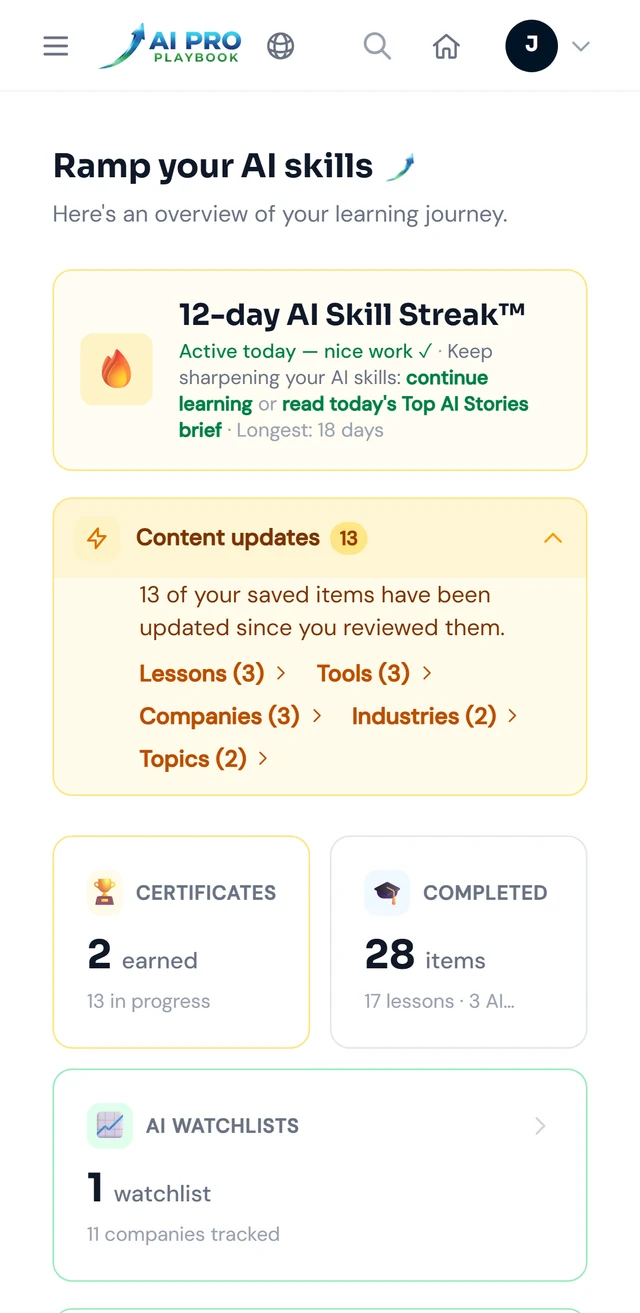
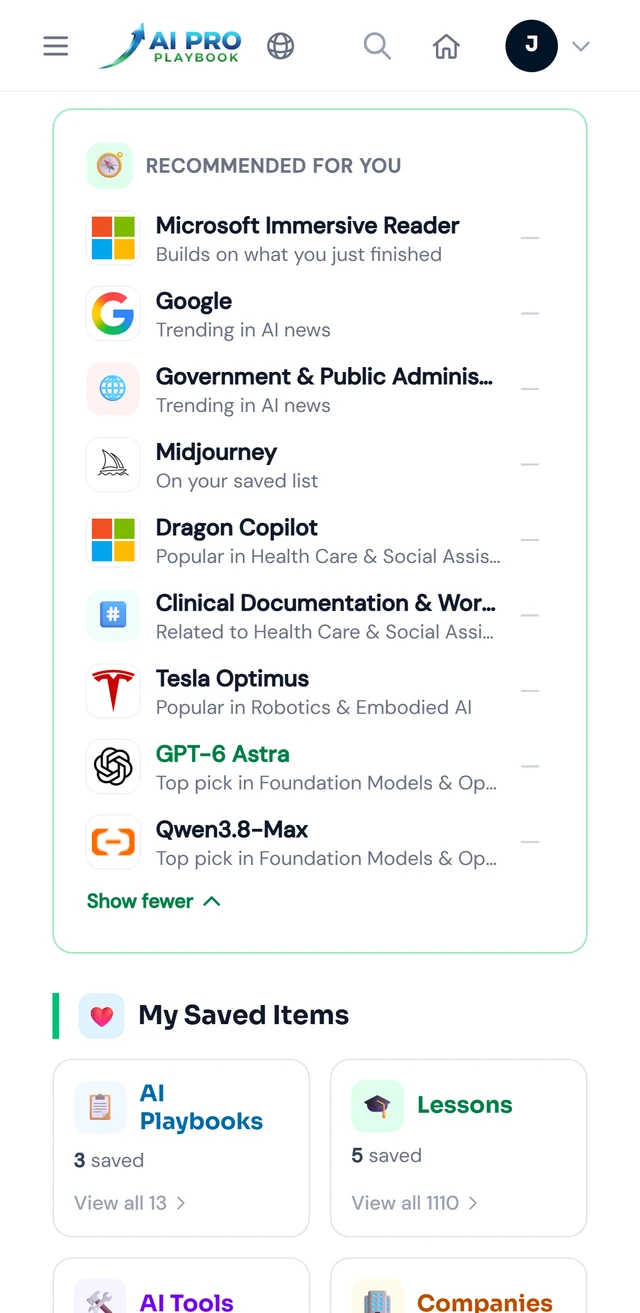
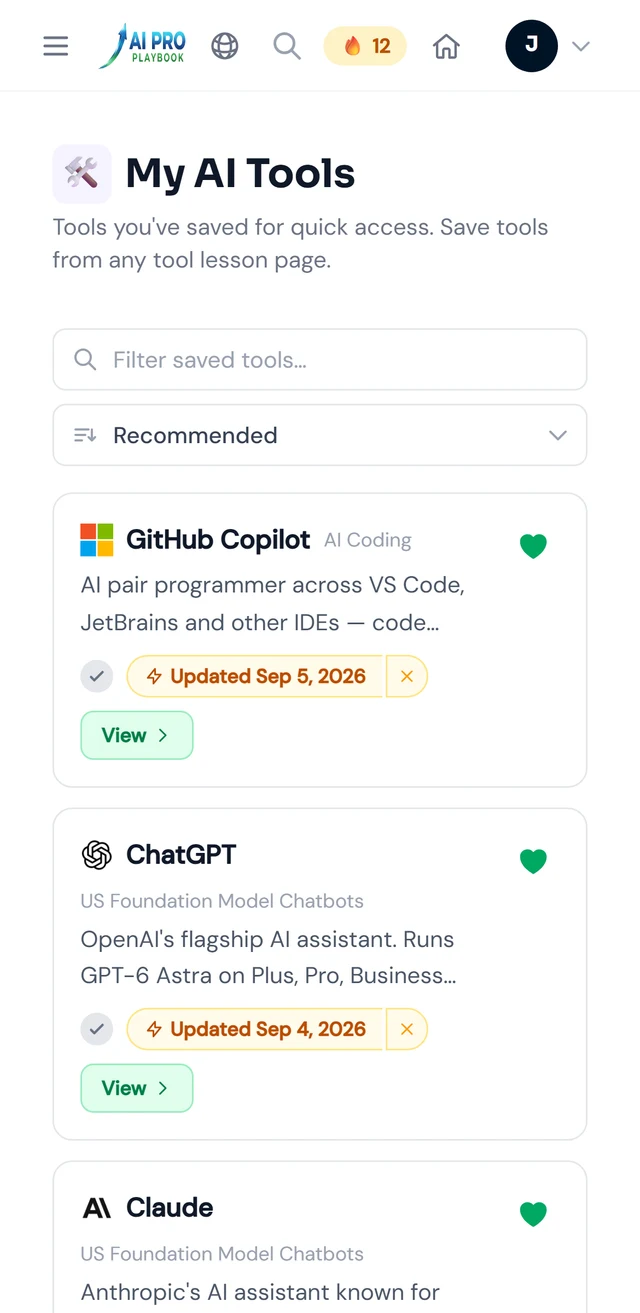
Swipe for Recommended for you and My AI Tools
Your AI Hub — sample data. See desktop view example