🏭Industry Overview
Updated May 16, 2026Justice, Public Order, and Safety Activities (NAICS 9221) covers federal law enforcement (FBI, DEA, ATF, US Marshals, ICE, CBP, Secret Service), state and local police (~18,000 US police departments), the federal and state court systems, federal/state/local corrections (~2.1 million incarcerated population, plus ~3.7 million on probation/parole), and emergency response services (fire, EMS). Combined US public-safety spending exceeds $400 billion annually across federal, state, and local levels. The US has the highest incarceration rate among developed nations, with substantial disparities by race and geography that have been the focus of policy reform efforts and litigation. The court system handles ~100 million case filings annually across federal, state, and local courts. Emergency response (911 call centers, fire departments, EMS) operates ~28,000 fire departments and a similar scale of EMS providers across the country.
🤖AI in Action
AI is being deployed across justice and public safety with significant policy controversy. Predictive policing tools (PredPol — now Geolitica — , HunchLab, ShotSpotter, Palantir Gotham deployments at LAPD and NYPD) have been heavily criticized for amplifying historical policing biases. Facial recognition (Clearview AI, used by 3,100+ US law enforcement agencies; NEC, Idemia government deployments) has been adopted widely with multiple jurisdictions banning use. Body-worn-camera AI (Axon, Motorola Solutions) increasingly auto-tags video, transcribes audio, and flags use-of-force incidents. AI-augmented case management (Tyler Technologies, Thomson Reuters CourtSmart) has expanded across courts. Risk-assessment tools (COMPAS, PSA — Public Safety Assessment) inform pretrial-release and sentencing decisions, with significant accuracy and fairness controversy (the ProPublica COMPAS investigation remains influential). 911 call-center AI helps triage and route calls. Wildfire and emergency-response AI (Pano AI, Cornea) detects fires from camera networks. Every major AI deployment in this sector faces civil-liberties scrutiny and ongoing regulatory uncertainty.
📊Impact on Jobs
Public-safety roles are growing in absolute headcount despite AI-augmentation pressure. Patrol officers and detectives are increasingly equipped with AI-augmented tools (license-plate readers, body-camera AI, mobile information systems with AI search) but the underlying role is stable. Crime analysts and intelligence analysts are heavily AI-augmented; the analyst-to-officer ratio at most major agencies has been growing. Corrections officers face AI augmentation in surveillance and risk-assessment but core role mixes are stable. Court reporters and clerks face direct AI displacement as automated transcription (Verbit, Otter.ai) and case-management AI handle work historically done by humans. Public defenders and prosecutors face heavy AI-tool adoption — AI legal research (Lexis+ AI, CoCounsel, Harvey) is now standard at well-resourced offices. New roles: police-AI-policy coordinator, body-camera-AI analyst, court-AI specialist, public-safety-data-science analyst. Civil-liberties oversight and AI-audit roles are growing across mayoral and state-AG offices.
Keep track of AI in your sector
- Save the sectors you follow
- Get ⚡ alerts when their tools and companies change
- The AI tools that actually ship here, from 900+ AI tool profiles
- Today’s top AI Stories — the day’s most important AI news, free
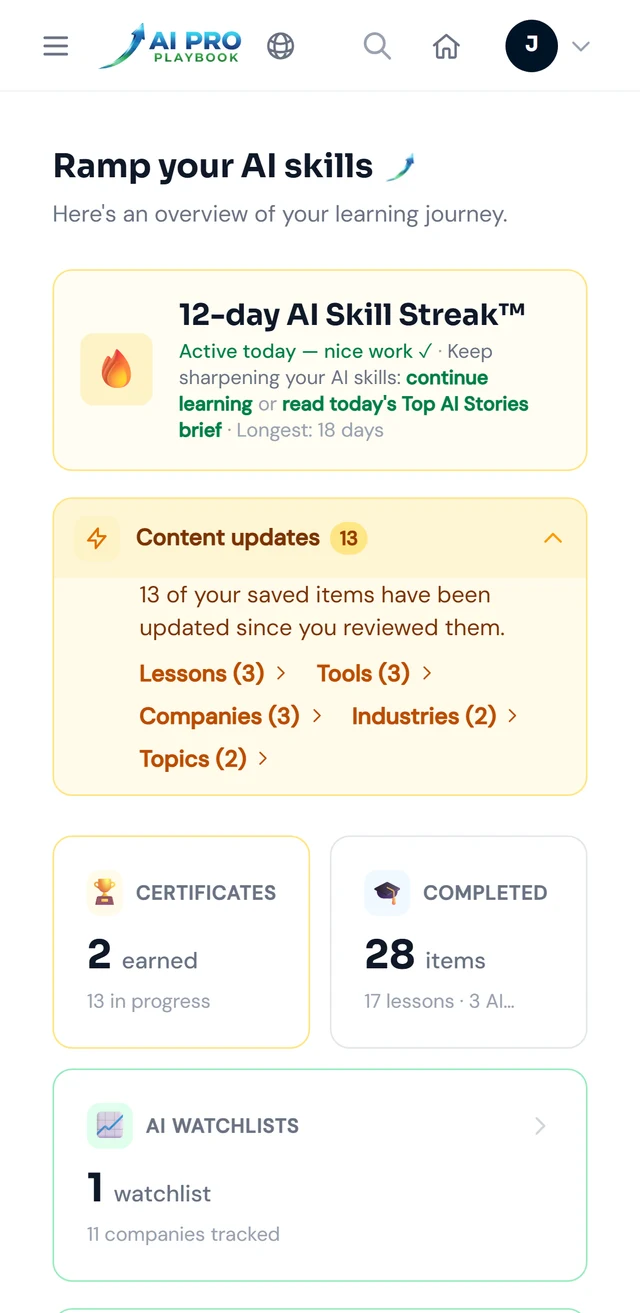

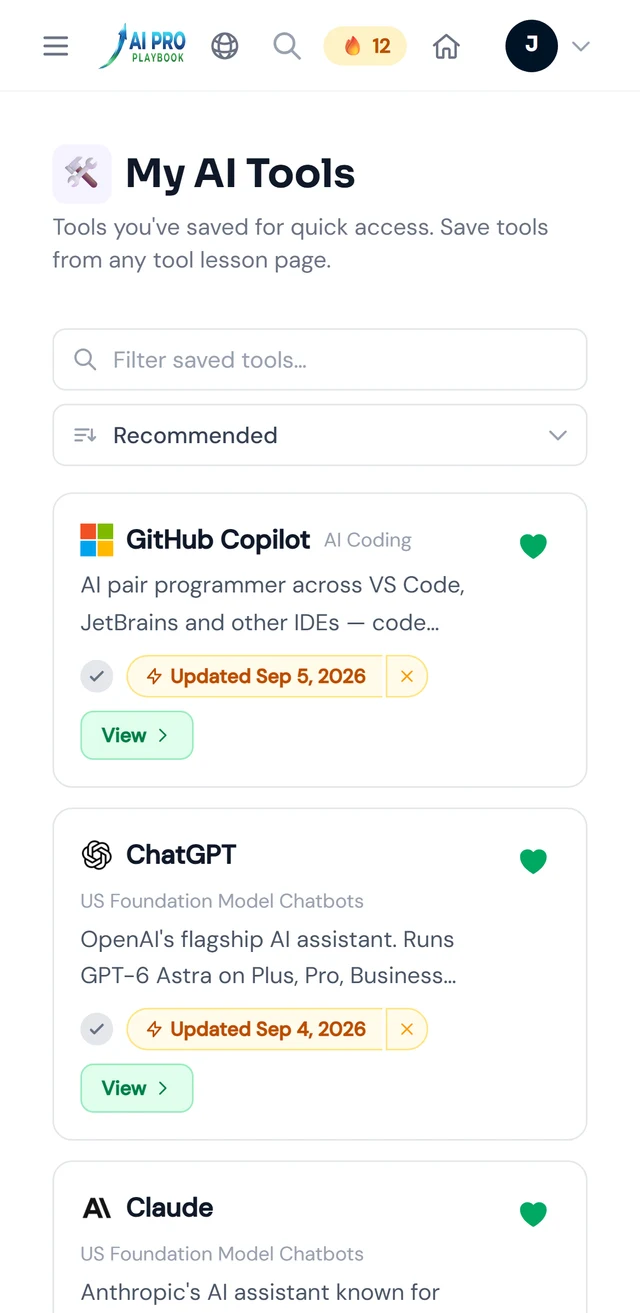
Swipe for Recommended for you and My AI Tools
Your AI Hub — sample data. See desktop view example
🛠️Top AI Tools in This Industry

 Flock Safety
AI camera network built on automated license-plate recognition and a shared police search network across 5,000+ communities.
 Peregrine
Data-integration and analytics platform that unifies siloed police data into a searchable real-time crime center.

 Skydio Drone as First Responder
Autonomous drones that auto-dispatch from a 911 or sensor trigger and stream live video to responders in under 90 seconds.
 Prepared
AI assistant for 911 call centers: real-time transcription, translation, location and multimedia intake, and triage. Now part of Axon.
 Mark43
Cloud-native computer-aided dispatch and records-management platform for police, now adding AI report assistance and search.
 Truleo
Natural-language processing that analyzes body-camera audio to flag officer conduct for accountability review.
 Abel Police
Y Combinator-backed startup automating police paperwork with AI report writing from body-cam footage and a CJIS-compliant assistant.