🏭Industry Overview
Updated May 22, 2026Semiconductor manufacturing in the US is a $230 billion+ industry undergoing rapid expansion. TSMC (Taiwan), Samsung (Korea), and Intel (US) operate the world's most advanced fabs at $20-30 billion+ capex per facility. Major US-headquartered design firms — NVIDIA, AMD, Qualcomm, Broadcom, Apple silicon — outsource fabrication to TSMC. The CHIPS Act has driven $200 billion+ in US fab investment. Lead times for advanced nodes (3nm, 2nm) stretch over a year. AI is uniquely critical here: AI chips are both the product AND a key tool in their own manufacturing.
💡The AI Opportunity
The AI-chip startup category is also gaining public-market footing. On May 4, 2026, Cerebras Systems filed to sell 28 million shares at $115 to $125 — targeting $3.5 billion in proceeds at a $26.6 billion valuation, the largest US tech IPO of 2026 so far. Cerebras becomes the first AI-specialized silicon company to reach a frontier-scale public listing, with OpenAI as one of its largest customers under a multi-year contract worth more than $10 billion. The offering serves as a public-market test of NVIDIA's GPU pricing power and of frontier-lab compute lock-in to specialized accelerator architectures.
🤖AI in Action
NVIDIA's CUDA and cuDNN platforms power the AI training that designs the next generation of chips. Synopsys DSO.ai and Cadence Cerebrus apply reinforcement learning to chip-floorplan optimization — Google demonstrated AI-designed TPU layouts in 2021. ASML uses AI throughout its EUV lithography platforms for overlay and dose control. Defect-inspection AI (KLA Tencor, Applied Materials, ASML) classifies wafer defects at production speeds. Tenstorrent and Cerebras compete with NVIDIA on AI training chips, while AMD's Instinct line (currently MI355X with 288 GB HBM3e, the announced MI400 series targeting NVIDIA Vera Rubin in 2026) is the at-scale second source with public deployments at Oracle Cloud Infrastructure (130,000-plus GPU cluster), Microsoft Azure, and a 6-gigawatt multi-year OpenAI supply commitment from October 2025. SpaceX's Terafab joint venture (announced 2026) targets radiation-tolerant silicon for orbital AI. In April 2026, Intel and AMD jointly published the AI Compute Extensions (ACE) whitepaper through the x86 Ecosystem Advisory Group — a new x86 instruction-set extension that adds two-dimensional tile registers and outer-product matrix-multiply instructions on top of AVX10, with a claimed 16-times compute-density improvement on matrix workloads. Unlike Intel's Xeon-only AMX, ACE targets both client and server silicon, making it the first cross-vendor x86 standard for on-CPU AI inference; software enablement is in flight for PyTorch, NumPy, and TensorFlow. On May 6, 2026, San Francisco lab Zyphra released ZAYA1-8B — the first public claim of a frontier-quality math model trained entirely on AMD Instinct MI300X (1,024-node cluster with AMD Pensando Pollara networking, no NVIDIA dependency). The model matches DeepSeek-R1 on AIME 2026 and HMMT despite an order-of-magnitude smaller active-parameter footprint, and reinforces that AMD's Instinct line — alongside Cerebras and Groq — is now demonstrably capable of training frontier-quality reasoning models outside the NVIDIA CUDA stack.
NVIDIA's Q1 fiscal 2027 results — record $81.6 billion in revenue with $75.2 billion from data center, and forward guidance of $91 billion — confirm the GPU vendor's continued dominance even as competitors close the architectural gap. The same earnings introduced Vera, NVIDIA's first CPU purpose-built for agentic AI workloads, positioned by Jensen Huang as a "brand new $200 billion total addressable market" for autonomous-acting agents that behave like users and require CPU-driven tooling alongside GPU inference. Combined with NVIDIA's $43 billion non-marketable startup-equity portfolio (including a $30 billion OpenAI commitment paired with capacity expansion that Huang described as "quite significant"), the AI semiconductor stack is now anchored on a single supplier across hardware, software (CUDA), AND structural capital — sharpening the question of how concentrated AI infrastructure has become around one vendor.
Cerebras Systems completed the largest US tech IPO of 2026, pricing 28 million shares at $185 above the $115 to $160 range for $5.5 billion in proceeds; the stock more than doubled on debut to close at $311 for a $66 billion market cap. The S-1 named OpenAI, Group 42, Saudi Arabia's MBZUAI, and AWS as top customers, disclosed OpenAI's multi-billion-dollar customer agreement and post-listing shareholder position via warrants, and confirmed Cerebras swung to profitability on $510 million of 2025 revenue. The public-market debut is the first frontier-scale AI silicon listing — a practical test of whether the answer-inference workload bet against NVIDIA's GPU pricing power can clear public-market scrutiny, and a new public-market currency for Cerebras to chase NVIDIA data-center share more aggressively.
US industrial policy on advanced computing has converged on an equity-stake-for-capital model. Following the Trump administration's Intel deal — which converted roughly $5.7 billion in CHIPS Act funding into approximately 433 million Intel shares — the Department of Commerce has extended the same structure to the quantum-computing sector, signing letters of intent for $2.013 billion in federal incentives across nine quantum firms in exchange for minority, non-controlling equity stakes. IBM anchors the package at roughly $1 billion, with GlobalFoundries at $375 million on the foundry side and seven computing companies — Atom Computing, Diraq, D-Wave, Infleqtion, PsiQuantum, Quantinuum, and Rigetti — splitting the remaining capital. While quantum computing sits adjacent to the classical AI accelerator stack rather than inside it, the same federal posture now applies across both: the US government is increasingly choosing to take equity in strategic compute companies rather than fund them through grants alone, with downstream implications for how the next generation of AI infrastructure capital (especially long-horizon research-grade compute) is raised and deployed.
📊Impact on Jobs
Chip-design productivity has improved meaningfully — Synopsys reports 10-30% PPA gains from AI-augmented design. Junior chip-designer roles see slowing growth as AI handles routine layout work. Senior architects and verification engineers gain leverage. Wafer-defect inspection roles shift from manual classification to AI-output review. Process engineers benefit from AI-driven yield analysis. New roles: AI chip-design researcher, fab AI-integration engineer, CHIPS-Act program manager for AI manufacturing standup.
Keep track of AI in your sector
- Save the sectors you follow
- Get ⚡ alerts when their tools and companies change
- The AI tools that actually ship here, from 900+ AI tool profiles
- Today’s top AI Stories — the day’s most important AI news, free
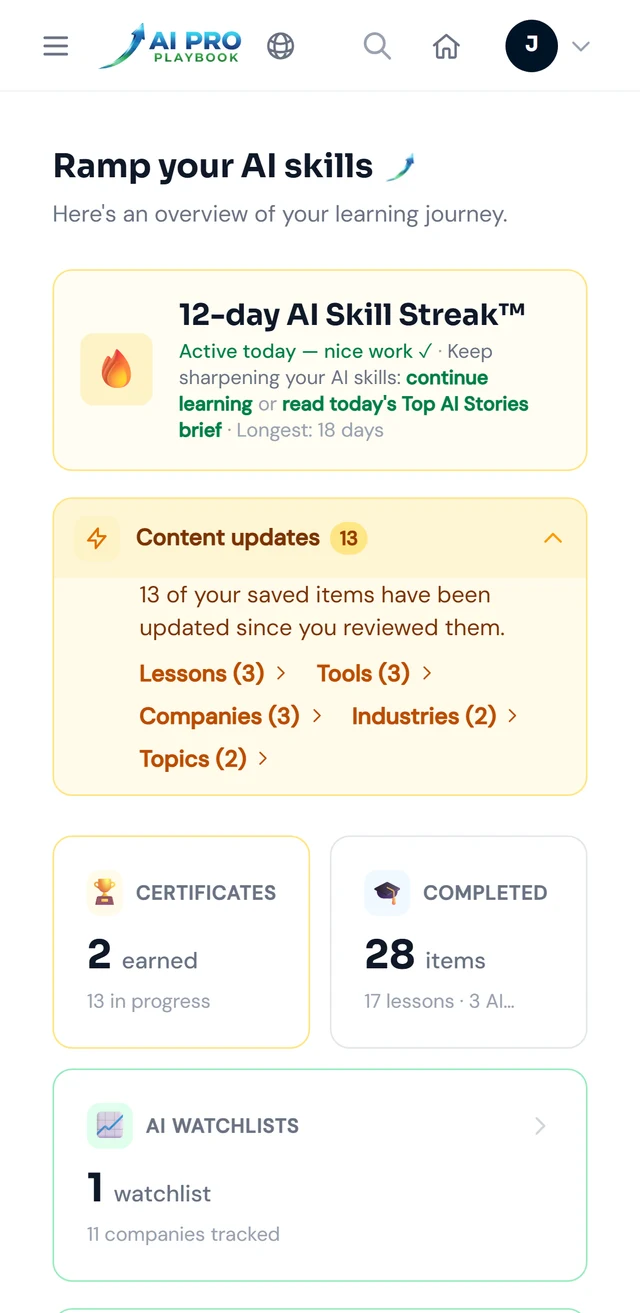

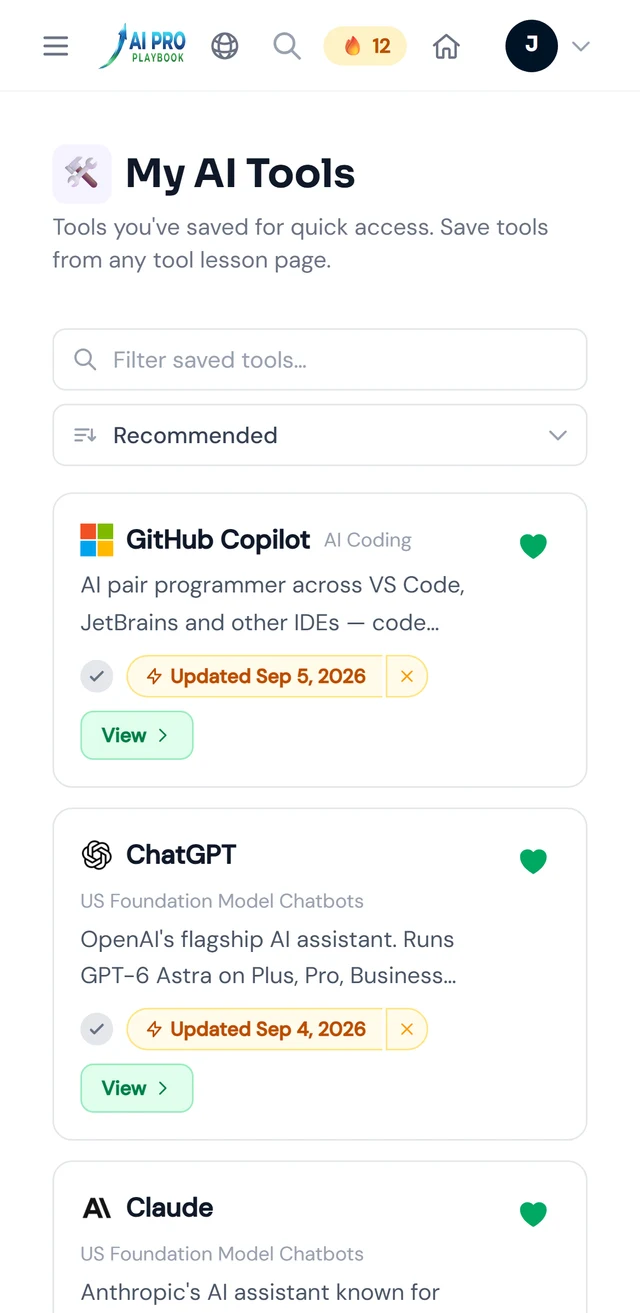
Swipe for Recommended for you and My AI Tools
Your AI Hub — sample data. See desktop view example
🛠️Top AI Tools in This Industry




AI inference platform powered by wafer-scale processors. The CS-4 rack system (August 2026) runs models above 10 trillion parameters at more than 1,000 tokens per second; the hosted cloud serves open models up to 480 billion parameters. Partners include OpenAI, AMD, AWS and Meta.

 ChatGPT
OpenAI's flagship AI assistant. Runs GPT-6 Astra on Plus, Pro, Business and Enterprise since September 3, 2026, with GPT-5.6 Luna still the free default and unlimited free text chats. Includes GPT Image 2, full-duplex voice, Deep Research, ChatGPT Health, Sites for building and hosting web apps, and an auto-enrolled restricted mode for under-18s.
 Claude
Anthropic's AI assistant known for long-context reasoning, coding, and following nuanced instructions, with a 1 million token context window. Offers the current Claude lineup from the economical Opus tier up to the Fable flagship. Strong safety and helpfulness balance.

 Averroes
No-code AI defect-detection platform combining supervised deep learning with unsupervised anomaly detection; retrofits legacy AOI at semiconductor scale.