🏭Industry Overview
Updated May 16, 2026US hospitals generate over $1.2 trillion annually and employ more than 6 million people across 6,000+ facilities. The industry includes nonprofit health systems (Kaiser, Cleveland Clinic, Mayo, HCA), for-profit chains (HCA Healthcare, Tenet, Universal Health Services), and academic medical centers. Hospitals operate on thin margins (average 1-3%) and face simultaneous pressures from staffing shortages, capital-equipment costs, and value-based payment models. AI deployment has accelerated rapidly since 2023, with most major systems running multiple AI initiatives in parallel — clinical, operational, administrative.
🤖AI in Action
Epic and Oracle Health (Cerner) embed AI across their EHR workflows — chart summarization, in-basket message replies, sepsis prediction. Microsoft Dragon Copilot is the leading ambient-AI documentation tool. Aidoc, Viz.ai, and HeartFlow handle radiology and cardiology AI triage. Bayesian-monitoring platforms (Bayesian Health, Etiometry) predict ICU deterioration hours in advance. Operational AI — Qventus, LeanTaaS — optimizes OR scheduling and patient flow. Revenue-cycle AI (Olive alumni, Notable, Innovaccer) automates prior auth and claims management. An April 30, 2026 study in Science led by Harvard Medical School and Beth Israel Deaconess Medical Center found OpenAI's o1 reasoning model arrived at the exact or near-exact diagnosis in 67% of 76 emergency-room triage cases, versus 55% and 50% for two attending internal-medicine physicians working from the same text-only EHR inputs. The authors emphasized that prospective real-world trials are still required before any clinical deployment.
📊Impact on Jobs
Clinical documentation burden is being significantly reduced for physicians and nurses. Predictive analytics catch deteriorating patients earlier — early sepsis prediction has reduced mortality 18-25% in deployment studies. Operational AI improves bed turnover, OR utilization, and emergency-department throughput. Administrative roles (medical coding, prior-authorization processing, denials management) face the steepest displacement. Clinical roles are largely augmented rather than replaced — staffing shortages mean AI fills gaps. New roles: clinical AI safety officer, AI-output bias auditor, ML model lifecycle manager.
Keep track of AI in your sector
- Save the sectors you follow
- Get ⚡ alerts when their tools and companies change
- The AI tools that actually ship here, from 900+ AI tool profiles
- Today’s top AI Stories — the day’s most important AI news, free
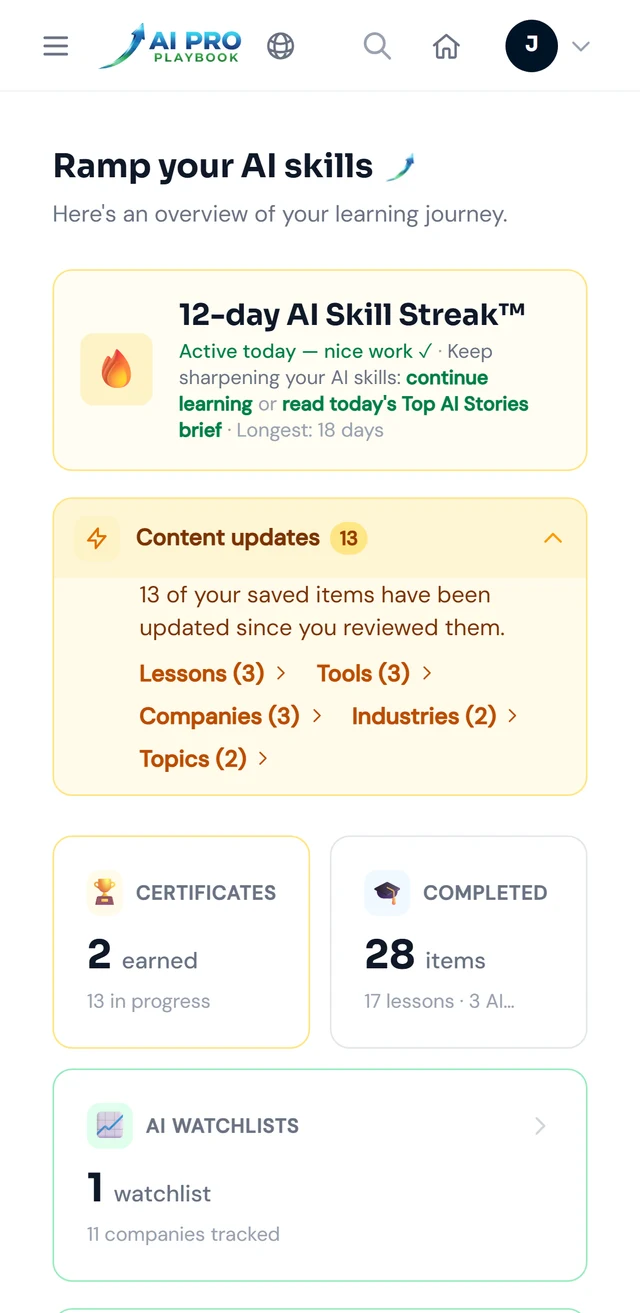
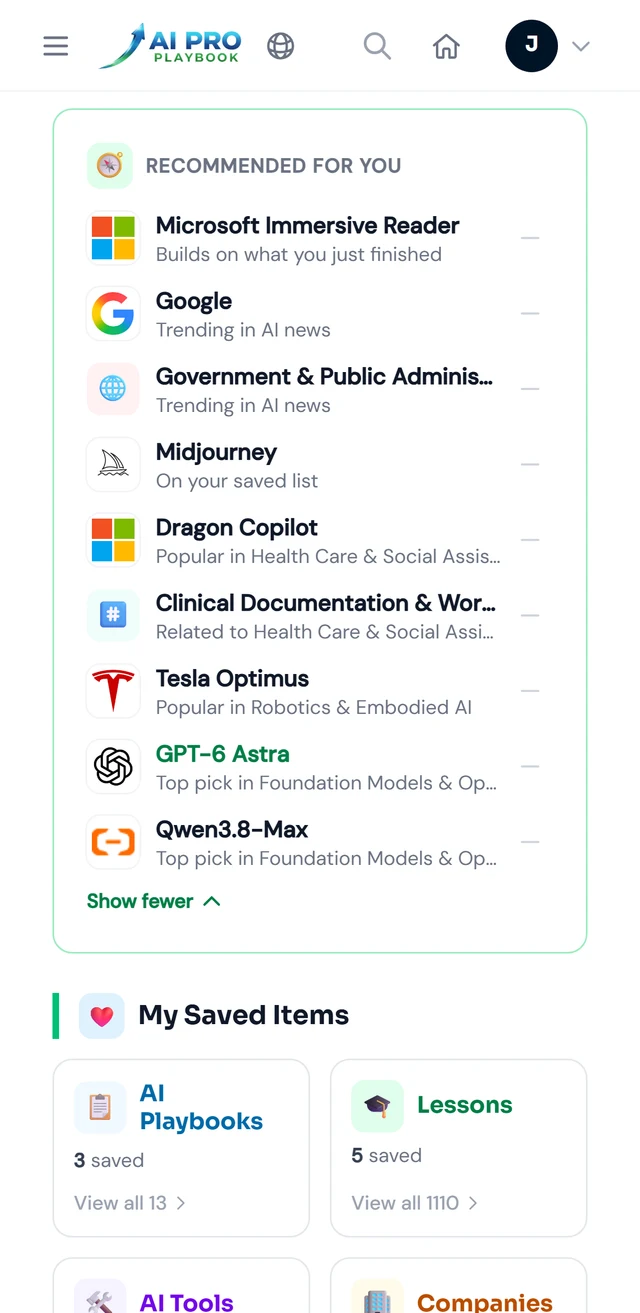
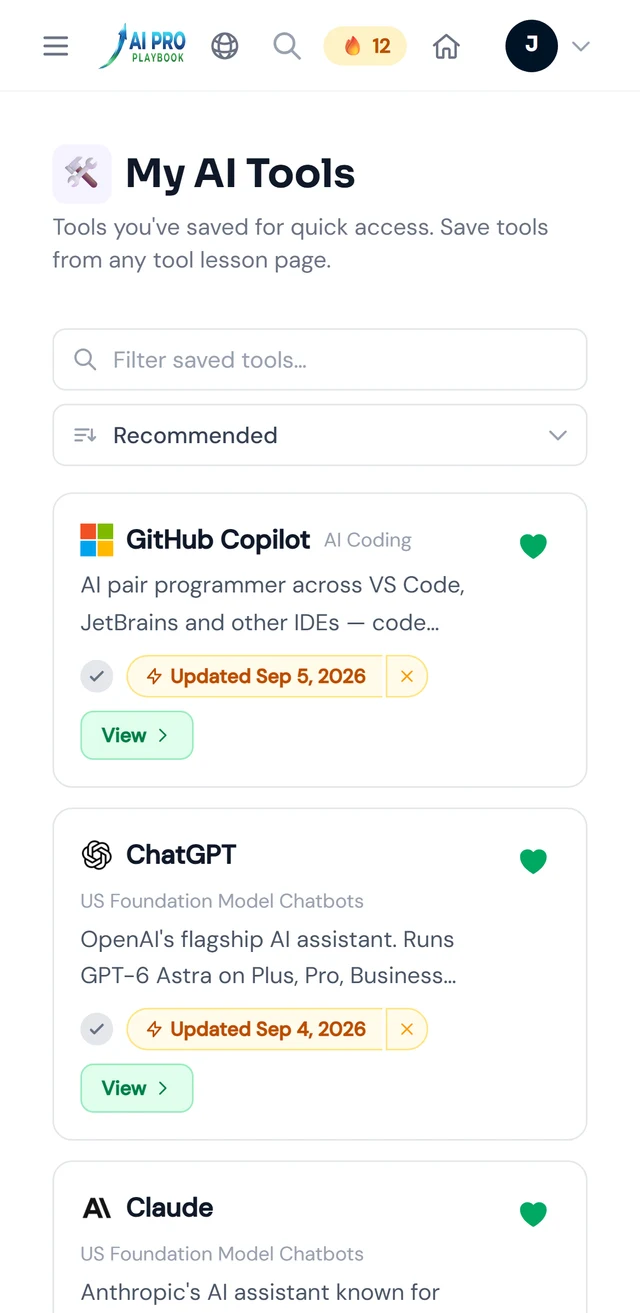
Swipe for Recommended for you and My AI Tools
Your AI Hub — sample data. See desktop view example
🛠️Top AI Tools in This Industry
 Epic Cosmos
Epic's embedded AI features — Cosmos research database (250M+ patient records), Inbox-message drafting, summarization, and predictive insights inside the Epic EHR.
 Innovaccer
Healthcare data and AI platform unifying clinical, claims, and operational data for hospitals — supports population health, care management, and physician workflows.

Microsoft clinical AI assistant (formerly Nuance DAX) that listens to patient-physician encounters and auto-generates SOAP notes, visit summaries, referral letters, and after-visit instructions. Agentic capabilities handle prior authorizations and medication refills. Deployed at 600+ health systems.
 Aidoc
AidocAI radiology triage platform with 30 FDA-cleared tools. First comprehensive foundation model AI triage detecting 14 critical findings from a single abdominal CT with 97% sensitivity.


 ChatGPT
OpenAI's flagship AI assistant. Runs GPT-6 Astra on Plus, Pro, Business and Enterprise since September 3, 2026, with GPT-5.6 Luna still the free default and unlimited free text chats. Includes GPT Image 2, full-duplex voice, Deep Research, ChatGPT Health, Sites for building and hosting web apps, and an auto-enrolled restricted mode for under-18s.
 Claude
Anthropic's AI assistant known for long-context reasoning, coding, and following nuanced instructions, with a 1 million token context window. Offers the current Claude lineup from the economical Opus tier up to the Fable flagship. Strong safety and helpfulness balance.
 Commure
AI-native healthcare platform unifying ambient documentation, revenue-cycle management, and hospital operations across hundreds of provider organizations; parent of ambient-scribe Augmedix.
 Qventus
AI operational assistants for hospitals that automate patient flow, discharge planning, and OR scheduling — targeting capacity, length-of-stay, and throughput.
 Bayesian Health
Continuous, real-time AI monitoring of inpatients for sepsis and clinical deterioration — with a landmark FDA clearance for continuous AI sepsis monitoring.
 Theator
Surgical-intelligence AI that analyzes operating-room video to support surgeon performance, training, and automated operative documentation across hundreds of thousands of procedures.
 CodaMetrix
Autonomous AI medical coding for large health systems — translates clinical documentation into billing codes across specialties, with audit trails and human oversight.
Voice-AI agents that automate healthcare phone calls to payers — benefit verification, prior-auth status, and member services — built on a knowledge graph from millions of calls.
 Cohere Health
AI prior-authorization and utilization-management automation for health plans and providers — speeding approvals for appropriate care and cutting denials and delays.
 Regard
AI that reads EHR chart data to surface missed or under-documented diagnoses, draft care plans, and automate notes — improving diagnosis capture and documentation integrity.
 RapidAI
Stroke and neurovascular imaging AI — automated large-vessel-occlusion detection, CT perfusion, and triage that speeds treatment across stroke networks. The principal Viz.ai rival.
 Hippocratic AI
Safety-focused, patient-facing generative-AI agents that handle non-diagnostic clinical outreach — post-discharge calls, chronic-care check-ins, and care management — at scale, escalating to human staff when needed.